News
German 10×80 Flak Binoculars: History, Models & Wartime Use
Sep
German 10×80 Flak Binoculars: History, Models & Wartime Use
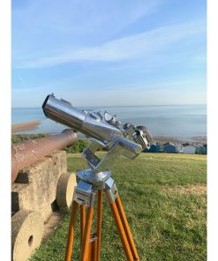
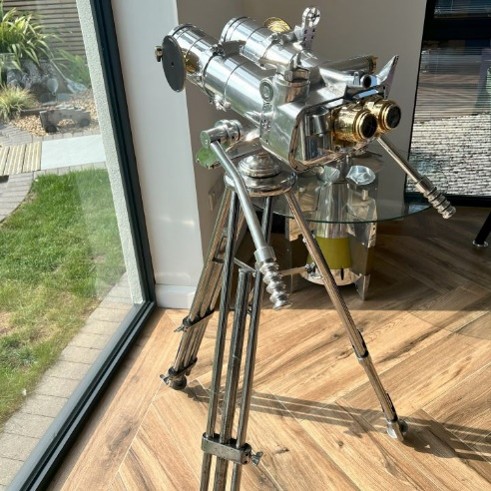
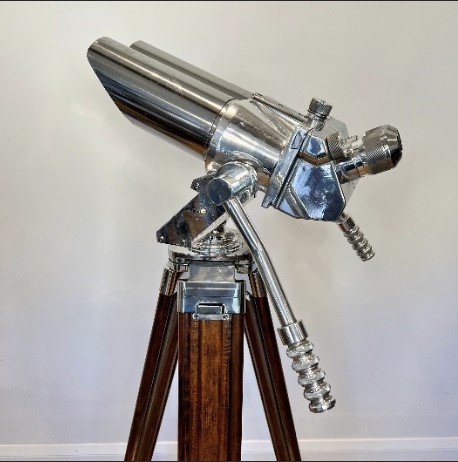
German 10×80 Flak binoculars, also known to collectors as Flakglas or Flakfernrohr, are among the most distinctive military optical instruments of the Second World War.
Designed primarily for long-range observation and aircraft identification, these large tripod-mounted binoculars combined 10x magnification with 80mm objective lenses and sophisticated German optical engineering.
Their story, however, begins long before the Second World War. The development of the 10×80 Flak binocular was influenced by Germany’s established optical industry, advances in military aviation and the increasing importance of anti-aircraft defence during the 1920s and 1930s.
In this guide, Aviation & Binoculars explores the history and development of German WW2 10×80 binoculars, their manufacturers and different variants, the wartime markings found on surviving examples and how these impressive optical instruments were used by German forces during the Second World War.
The Origins of German Military Optics
Germany entered the twentieth century with an internationally important optical industry.
Two names particularly relevant to its development were Carl Zeiss and Otto Schott.
Otto Schott (1851–1935) was a pioneering German chemist whose systematic research into glass helped establish modern glass science. His work led to the development of specialist glasses with precise and reproducible properties, providing optical designers with materials capable of achieving increasingly sophisticated results.
Carl Zeiss had founded his optical workshop in Jena in 1846, initially specialising in microscopes and other precision optical instruments.
The development of new optical glass by Schott and the relationship between Schott’s glassmaking expertise and Zeiss optical design contributed significantly to advances in German optical technology.
By the early twentieth century, German manufacturers had established an international reputation for precision optical equipment.
WW1 and the Development of Military Observation Optics
During the First World War, binoculars and other optical instruments became increasingly important to military operations.
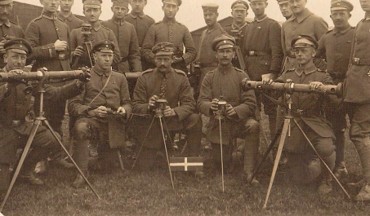
German forces made extensive use of binoculars for tasks including artillery spotting, reconnaissance and long-range observation.
The experience gained during WW1 demonstrated the military importance of high-quality optics and, in particular, the need for high-magnification instruments capable of accurately observing objects over considerable distances.
These lessons helped establish the technological foundations for the development of increasingly sophisticated, large, tripod-mounted military binoculars during the interwar period.
By the 1930s, the requirement for these instruments was about to become even more important.
The Rise of Air Power and the Need for Flak Optics
The 1920s and 1930s saw enormous advances in aviation.
Aircraft became faster, flew higher and could operate over increasingly long distances. Military planners understood that air power would play a major role in any future conflict.
Germany’s rearmament during the 1930s therefore placed considerable emphasis on anti-aircraft defence.
Detecting, identifying and tracking aircraft required specialised optical instruments.
The requirements for these binoculars included:
- High magnification, including 10x, 12x, 20x and 30x
- Large 60–80mm objective lenses for increased light gathering
- Wide fields of view to help observers track moving aircraft
- Robust construction capable of withstanding military use
- Tripod or pedestal mounting for stability
- Angled eyepieces allowing observers to look upwards comfortably
- Weather-resistant construction
- Optical filters for different viewing conditions
Some examples incorporated adjustable internal light filters marked Klar (Clear), Mittel (Medium) and Dunkel (Dark).
Producing an instrument capable of meeting these requirements involved considerable engineering and manufacturing expertise.
Development of the German 10×80 Flak Binocular
The German military established demanding criteria for a new large-aperture observation binocular.
According to the historical information used by Aviation & Binoculars, Emil Busch AG of Rathenow won the design contract for the 10x binocular, leading to the development of the design now widely known among collectors as the 10×80 Flakglas, Flakfernrohr or Flak binocular.
Production subsequently continued during the Second World War, with the design being manufactured by several companies.
The 10×80 combined a substantial optical system with a mounting arrangement designed for stable observation.
German 10×80 Flak Binocular Specifications
Typical specifications described for these instruments include:
- Magnification: 10x
- Objective lenses: 80mm
- Objective design: Cemented achromatic objectives
- Focal length: 280mm
- Eyepieces: 70-degree
- Prism system: 45-degree Schmidt roof prisms
- Mounting: Tripod or pedestal
The combination of 10x magnification and large 80mm objective lenses provided the observer with a bright image while retaining the field of view needed to locate and follow aircraft.
The angled optical arrangement also made prolonged observation of the sky considerably more practical than attempting the same task with conventional straight-through binoculars.
German 10×80 Flak Binocular Models and Variants
Although the 10×80 Flak binocular is commonly discussed as a single type, collectors can encounter different configurations and manufacturers.
Standard 10×80 Flak Binoculars
The classic German 10×80 Flakglas was designed primarily for observation associated with anti-aircraft operations.
These binoculars could be positioned on a substantial tripod or other mounting system, allowing an observer to scan the sky and track aircraft without having to support the considerable weight of the instrument.
Their combination of size, optical performance and distinctive appearance makes surviving examples particularly recognisable today.
Kriegsmarine 10×80 Binoculars
A different configuration was produced for use at sea.
The Kriegsmarine 10×80 binoculars described in the Aviation & Binoculars collection feature a 20-degree inclined eyepiece arrangement and extended rain shields.
These extended shields are an immediately noticeable feature and helped make the binoculars better suited to a naval environment.
Surviving Kriegsmarine examples are particularly interesting to collectors because of their distinctive configuration and association with German naval operations.
Zeiss 12×60 Binoculars
The 10×80 was not the only large German military binocular used during the Second World War.
The Zeiss 12×60, commonly encountered with the wartime manufacturer code blc, provided greater magnification and a more focused view of the target.
These binoculars were particularly associated with range finding equipment used on land and at sea.
Aviation & Binoculars has restored and serviced surviving examples of both 10×80 and 12×60 German military binoculars.
German WW2 Binocular Manufacturers and Codes
One of the most interesting areas for today’s collector is the system of German wartime manufacturer codes.
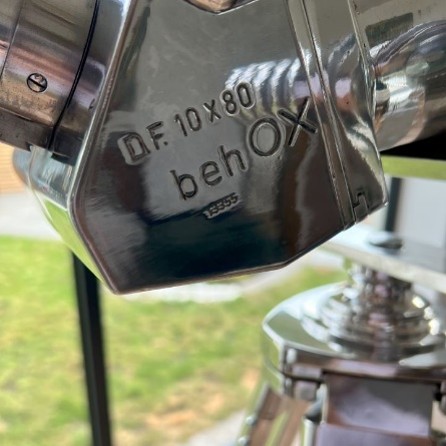
Early Busch examples may display the manufacturer’s name. During the war, however, German military equipment increasingly used letter codes rather than displaying the full identity of the manufacturer.
Aviation & Binoculars has encountered a number of manufacturer codes on surviving military binoculars, including:
| Code | Manufacturer |
|---|---|
| beh | E. Leitz, Wetzlar |
| dkl | Schneider, Bad Kreuznach |
| cro | R. Fuess, Berlin-Steglitz |
| bpd | C.P. Goerz, Vienna |
| eug | Optische Präzisions-Werke, Warsaw |
| cxn | E. Busch, Rathenow |
These markings can normally be found on the main housing and can provide an important starting point when researching the manufacturer of a surviving set of German WW2 binoculars.
The complete WW2 manufacturer list can also be found elsewhere on the Aviation & Binoculars website.
What 20 Years of Handling German Military Binoculars Has Taught Us
One of the advantages of handling historic optics over many years is the opportunity to compare examples produced by different manufacturers.
Aviation & Binoculars has more than 20 years’ experience with historic binoculars and military optics.
Despite the number of different manufacturers involved in wartime production, our experience of handling these binoculars has revealed remarkably little variation in overall build quality between manufacturers.
Considering the conditions under which wartime production took place, this consistency is an impressive feature of these historic optical instruments.
It is also one reason why manufacturer codes, markings, configuration, condition and individual history can be particularly interesting when comparing surviving examples today.
Understanding D.F., Blue O and Other 10×80 Markings
Manufacturer codes are not the only markings collectors may encounter.
The side housing of a set of German 10×80 binoculars can contain additional letters and symbols that provide further information about the instrument.
What Does D.F. Mean?
D.F., when engraved before 10×80, stands for the German Doppelfernrohr, literally meaning “double telescope”.
What Does the Blue O Mean?
According to Aviation & Binoculars’ reference information, a blue ‘O’ appeared around 1942 and indicated the use of grease capable of withstanding cold-weather conditions.
This followed experience in the extreme temperatures encountered during operations in Russia.
Red or White X and Triangle Markings
Red or white X or triangle markings can also be encountered on 10×80 Flak optics.
These are associated with changes to the lubrication used within the instruments, including re-greasing to replace earlier cold-weather lubrication.
These small details are particularly interesting to collectors because they can help reveal aspects of an instrument’s manufacture, servicing and intended operating conditions.
How Were 10×80 Flak Binoculars Used During WW2?
The engineering behind these instruments becomes easier to understand when considered in the context of their intended use.
Early Warning and Aircraft Identification
Before radar became widespread, visual observation played an important role in detecting approaching aircraft.
Observers using large military binoculars could attempt to:
- Identify aircraft type
- Estimate altitude and speed
- Determine the direction of approach
- Track moving aircraft
- Relay observations to command posts
The wide field of view and substantial light-gathering capability of the 10×80 made it well suited to this role.
The 10×80 and Zeiss 12×60 were among the large optical instruments used for these types of observation.
Anti-Aircraft Batteries and Rangefinding
Large observation binoculars formed one part of a much wider anti-aircraft defence system.
10×80 binoculars could be used for identifying attacking aircraft and assisting the operation of equipment including large rangefinders, searchlights and anti-aircraft batteries positioned around German cities and other strategically important locations.
The binoculars therefore did not operate in isolation.
Information obtained by observers could contribute to the wider process of detecting, following and engaging an approaching aircraft.
Searchlight Coordination
Night-time aircraft interception created another significant challenge.
Searchlights were used to illuminate aircraft so they could be tracked and engaged by anti-aircraft defences.
Optical observation equipment played a role in this process, helping observers locate and track targets and coordinate searchlight activity.
The large objective lenses of military observation binoculars were particularly valuable where available light was limited.
Kriegsmarine and Naval Use
Large German military binoculars were also employed at sea.
Kriegsmarine units used 10×80 and 12×60 binoculars for activities including:
- Spotting aircraft
- Navigational observation
- Long-range observation
- Rangefinding assistance
Naval examples could incorporate features appropriate to maritime use, including extended rain shields and additional protection against the marine environment.
These differences mean that naval examples can be visually distinct from binoculars associated primarily with land-based anti-aircraft operations.
Why German 10×80 Flak Binoculars Remain Collectable
More than 80 years after the end of the Second World War, German 10×80 Flak binoculars remain impressive examples of wartime optical engineering.
Their appeal today comes from several areas.
They are substantial pieces of military history, represent sophisticated optical engineering and can display fascinating differences in manufacturer, wartime markings and military configuration.
Their sheer physical presence also makes them very different from conventional vintage binoculars.
Importantly, surviving examples should not necessarily be regarded solely as static historical objects. When correctly inspected, restored and serviced, historic military binoculars can remain usable optical instruments.
For Aviation & Binoculars, preserving that combination of history and usability is an important part of working with these remarkable pieces of equipment.
Frequently Asked Questions About German 10×80 Flak Binoculars
What does 10×80 mean on German binoculars?
The designation 10×80 refers to 10-times magnification combined with 80mm objective lenses. The large objectives provide significant light-gathering capability compared with conventional handheld binoculars.
What is a Flakglas?
Flakglas is a term commonly used by collectors when referring to large German observation binoculars associated with anti-aircraft or Flak operations during the Second World War.
What is a Flakfernrohr?
Flakfernrohr refers to an optical observation instrument associated with anti-aircraft use. The terminology surrounding surviving German military optics can vary between original descriptions and terms now commonly used by collectors.
Who manufactured German 10×80 Flak binoculars?
10×80 binoculars were produced by several manufacturers. Surviving examples may display wartime manufacturer codes such as cxn, associated with Emil Busch, and beh, associated with E. Leitz, alongside other codes.
What were German 10×80 binoculars used for?
Their wartime roles included aircraft observation and identification, assisting anti-aircraft operations, searchlight coordination and other forms of long-range military observation. Variants were also used in naval environments.
Can German WW2 binoculars still be used today?
Depending upon their condition, yes. A correctly serviced and aligned set of historic military binoculars can remain a usable optical instrument many decades after it was manufactured. Optical condition and professional servicing are therefore particularly important.
German 10×80 Flak Binoculars Today
Surviving German WW2 Flak binoculars can differ considerably according to their manufacturer, military application, markings, configuration, originality and condition.
These differences are part of what makes researching and collecting historic military optics so interesting.
Aviation & Binoculars has more than 20 years’ experience handling historic binoculars and has encountered examples produced by numerous wartime manufacturers.
If you are considering purchasing a set, read our Buyer’s Guide to WW2 ‘Big Eye’ Binoculars, where we explain what collectors should look for when considering optical condition, originality, markings and usability.
You can also read our Guide to Identifying WW2 Binoculars or explore our current collections of WW2 Binoculars and Big Eye Binoculars.
If you have questions about a particular set of binoculars or are looking for a specific model, contact Aviation & Binoculars for specialist advice.