General
German WW2 Binocular Manufacturer Codes & Markings: 10×80 Reference Guide
Sep
German military binoculars produced during the Second World War frequently carry manufacturer codes, symbols and service markings rather than simply displaying the full manufacturer’s name.
For today’s collector, these markings can provide valuable clues when identifying and researching a set of German WW2 binoculars.
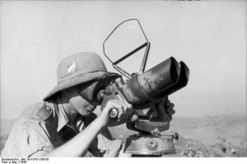
Among the most recognisable examples are the large German 10×80 Flak binoculars, also known to collectors as Flakglas or Flakfernrohr. Surviving examples can display a combination of manufacturer codes, serial numbers, optical specifications and lubrication or servicing markings.
Aviation & Binoculars has more than 20 years’ experience handling historic military binoculars and optics, including German 10×80 examples produced by different wartime manufacturers.
This reference guide explains some of the manufacturers and markings we encounter and provides an extensive directory of German wartime manufacturer codes for collectors and researchers.
For more information about the development and military application of these binoculars, read our German 10×80 Flak Binoculars: History, Models & Wartime Use guide.
Understanding German WW2 Binocular Manufacturer Codes
During the Second World War, German military equipment frequently carried coded manufacturer markings.
Rather than displaying the manufacturer’s full name, equipment could be identified using a short letter code.
For collectors today, these codes can be extremely useful when researching the origin of WW2 German military binoculars and other optical equipment.
A manufacturer code should not, however, be considered in isolation when determining the identity or authenticity of a historic instrument.
Other characteristics can include:
- Optical specification
- Construction and configuration
- Serial numbers
- Military markings
- Lubrication and service markings
- Original components
- Known provenance
- Evidence of later restoration or modification
If you are trying to establish whether a particular instrument is genuine, our Guide to Identifying Authentic WW2 Binoculars explains the wider identification process.
Key Manufacturers of German 10×80 Binoculars
Several manufacturers are particularly relevant when researching surviving German military binoculars.
The examples below are manufacturers and markings encountered within the Aviation & Binoculars collection and reference material.
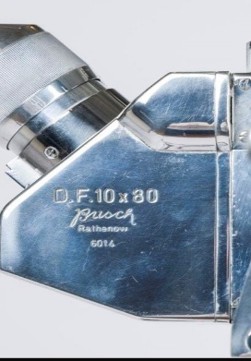
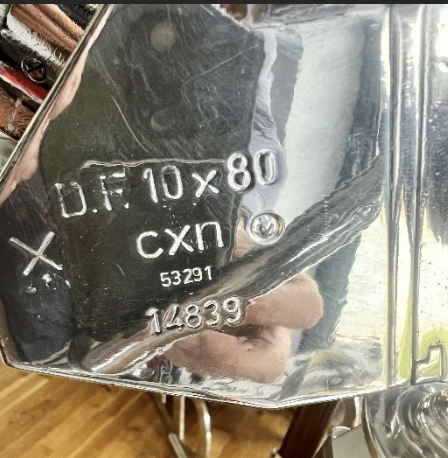
Emil Busch AG – cxn
Manufacturer code: cxn
Emil Busch AG was based in Rathenow, Brandenburg, west of Berlin, an important centre of German optical manufacturing.
According to the historical information used by Aviation & Binoculars, Emil Busch was involved in the original development of the German 10×80 Flak binocular design.
Early Busch examples are particularly interesting because the manufacturer’s actual name can sometimes be found on the main binocular housing rather than only a wartime manufacturer code.
Later examples can carry the three-letter cxn marking associated with Emil Busch.
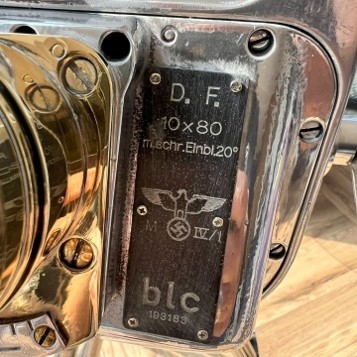
Carl Zeiss – blc
Manufacturer code: blc
Carl Zeiss of Jena is one of the best-known names in German optical history.
The company had a long history of precision engineering and the manufacture of cameras, lenses and scientific and military optical equipment.
German wartime optical equipment can be encountered carrying the blc manufacturer code associated with Carl Zeiss.
Aviation & Binoculars has handled examples carrying the blc marking, including examples associated with Kriegsmarine optical equipment.
Suggested image alt text: blc Carl Zeiss wartime manufacturer code on German military binoculars
Josef Schneider & Co. – dkl
Manufacturer code: dkl
Josef Schneider & Co. was based in Kreuznach in western Germany and was an important German optical manufacturer and wartime contractor.
The company is associated in the Aviation & Binoculars reference material with the dkl wartime manufacturer code.
Schneider also went on to manufacture the larger Doppelfernrohr 25×105 Flak “KQC” optical instrument referenced in our historical material.
Aviation & Binoculars has handled 10×80 examples carrying the dkl marking.
Suggested image alt text: dkl Schneider manufacturer marking on German WW2 10×80 binoculars
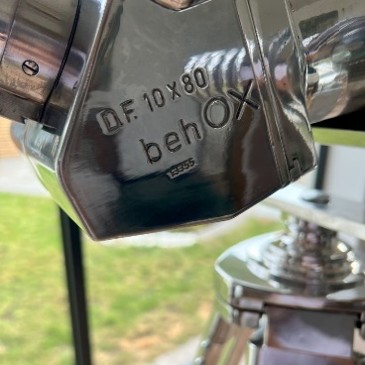
Ernst Leitz – beh
Manufacturer code: beh
Ernst Leitz GmbH of Wetzlar is another important German optical manufacturer represented within surviving wartime equipment.
The manufacturer’s wartime code is recorded in the Aviation & Binoculars reference material as beh.
The photograph below shows an actual set of 10×80 binoculars handled by Aviation & Binoculars carrying the beh marking together with additional service or lubrication markings.
Suggested image alt text: beh Ernst Leitz code and lubrication markings on German 10×80 binoculars
What 20 Years of Handling Military Binoculars Has Taught Us
Aviation & Binoculars has more than 20 years’ experience handling historic binoculars and military optics.
This has provided opportunities to examine surviving binoculars produced by numerous wartime manufacturers.
One particularly interesting observation from our experience is the consistency in the overall build quality found across the examples we have handled.
Considering the number of manufacturers involved and the conditions under which wartime production took place, this consistency demonstrates the standards applied to the manufacture of these specialised optical instruments.
Manufacturer is therefore only one consideration when assessing a set of historic binoculars.
Configuration, originality, optical condition, markings, servicing and the individual history of the instrument can all be equally interesting to today’s collector.
Additional Markings Found on German 10×80 Binoculars
The three-letter manufacturer code is not necessarily the only marking found on the housing of German 10×80 binoculars.
Additional letters and symbols can provide information associated with servicing, lubrication or the specification of the instrument.
These markings are particularly interesting because 10×80 binoculars were designed to operate across very different environments.
German forces operated in conditions ranging from the extreme cold of the Eastern Front to the heat and dust of North Africa, while naval equipment faced an entirely different set of environmental challenges.
German 10×80 Lubrication and Service Markings
According to the Aviation & Binoculars reference material, markings encountered on surviving examples include:
| Marking | Meaning in Aviation & Binoculars reference material |
|---|---|
| Light blue cross | -40 grease / winter warfare |
| X | Indicates further refurbishment |
| F | -20 degrees |
| Triangle | Further improvement |
| O | Lubricant code -20 |
| Kf | Cold-resistant lubricant associated with marine use – kalterfest |
These small markings can provide useful information, but they should always be interpreted alongside the other characteristics of the binoculars.
Where the precise interpretation of a historic marking is important to identification or provenance, collectors should consult appropriate specialist historical references rather than relying upon a single marking alone.
German WW2 Optical and Equipment Manufacturer Code Reference
The following reference list has been compiled from the Aviation & Binoculars source material.
Important: this is a broader wartime manufacturer-code reference and should not be interpreted as a list claiming that every company below manufactured German 10×80 binoculars.
The source material includes companies associated with optical equipment, cameras, cases, precision instruments and related wartime manufacturing. Some entries also contain uncertain or alternative attributions; these have been retained rather than presented as definitive.
For collectors specifically researching a German 10×80, the manufacturers discussed earlier in this guide are a more appropriate starting point.
German Wartime Manufacturer Codes A–B
bbw – Electroacustik KG, Kiel
bck – Bruninghaus & Co, Leder u. Metallwarenfabrik, Versmold
bef – Clemens Riefler, Fabrik Mathematischer Instrumente, Nasselwang/Bayern
beh – Ernst Leitz GmbH, Wetzlar, Germany
bek – Hensoldt Werk fur Optic und Mechanik, Herborn, Germany
bgu – Theodor Wuppermann GmbH, Walzwerk und Fassonschmiede, Koln
blc – Carl Zeiss Militarabteilung, Jena, Germany
bmh – K Jirasek Fabrik fur Feinmechanic und Optic, Prague, Czech
bmj – Hensoldt & Sohne Optische Werke A-G, Wetzlar, Germany
bmk – Srb & Stys Fabrik Praziser Messinstrumente, Prague, Czech
bmt – C A Steinheil & Sohne GmbH, Optische Werke, Munich, Germany
bpd – C P Goerz GmbH Optische Anstalt, Vienna, Austria
bvf – C Reichert Optische Werke, Vienna, Austria
bvu – Franz Kuhlmann, Wilhelmshaven, Germany
bwt – G Heyde K-G, Dresden, Germany
bxc – Kreiselgerate GmbH, Berlin
bxx – Askania Werke AG, Berlin
byg – Joh Wyksen K-G Optische Fabrik und Feinmachin, Katowitz, Poland
bzz – J G Farbenindustrie A-G Camerawerk, Munich, Germany (Agfa)
German Wartime Manufacturer Codes C
cad – Karl Kahles Optiker, Vienna, Austria
cag – Swarovski, Tyrol, Austria
cau – Kodak Aktiengesellschaft, Stuttgart, Germany
ccx – Hugo Meyer & Co Optische und Feinmechanische Werke, Gorlitz, Germany
cdc – Kern, Klager & Cie, Berlin (binocular cases)
clb – Dr F A Wohler, Kassel, Germany
clk – F W Breithaupt & Sohne Fabrik Geogatisher Instrumente, Kassel, Germany
cll – August Baumgart Feinmechanik & Prazisionmashinenbau, Rathenow
clm – Biedermann & Czarnikow, Berlin
cln – E Sprenger Optische-Mechanische Werkstatten, Berlin
cmc – Gegr Wichmann, Berlin
cmd – Ditto
cme – Ditto
cny – C Pose, Berlin – possibly binocular cases
crg – W Lambrecht, Instrumente, Gottingen, Germany
crh – F Schmidt & Haensch, Steglitz, Berlin
crj – Otto Fennel Sohne K-G, Instrumente, Kassel, Germany
crn – Friedrichs & Co, Hamburg – see also ctn
cro – R Fuess, Optische Industrie, Berlin
ctn – Freidricks & Co, Hanseatische Werkstatten fur Feinmechanik und Optik, Hamburg – see also crn
cwu – Georg von Kremp, Wetzlar, Germany
cxc – Dr Paul Mozar, Fabrik fur Feinmechanik, Dusseldorf, Germany
cxn – Emil Busch A-G, Optische Industrie, Rathenow
czn – Ditto
German Wartime Manufacturer Codes D
dag – Oculus, Berlin
ddv – Ditto
ddx – Voigtlander & Sohne A-G, Braunschweig, Germany
dho – Nordmark GmbH, Prerau, Czech
dhq – J D Moller GmbH, Wedel
dhv – Berliner Physikalische Werkstatten GmbH, Berlin
djg – J Veltjens K-G, Berlin
dkl – Jos Schneider & Co, Kreuznach, Germany
doq – Deutsche Spielgelglas A-G, Leine, Germany
dow – Opticotechna GmbH, Prerau or Optitechna, Brerau, Czech
dpg – Adox Kamerawerk GmbH, Wiesbaden, Germany
dpv – Zeiss Ikon A-G, Dresden, Germany
dpw – Zeiss Ikon A-G, Goerzwerk Kehlendorf Berlin
dpx – Zeiss Ikon A-G, Contessawerk, Stuggart, Germany
dqc – Eugen Ising, Metallwarenfabrik
dxt – Kadlec-Instrumente-Fabrik, Prague, Czech
dym – Runge & Kaulfuss, Rathenow – possibly also/or dyn
dys – Heinrich Zeiss, Berlin
dzl – Oigee GmbH Optische Anstalt, Berlin
German Wartime Manufacturer Codes E–F
eaf – Aude & Reipert Optische Industrie, Babelsberg, Germany
eaw – R Winkel GmbH Optische Industrie, Gottingen, Germany
ejo – Presswerk AG, Essen
eed – Kurbi & Niggeloh, Radevormwa, Germany
ehe – Rommler AG, Spremberg
emq – Karl Zeiss, Jena, Germany
emv – Hertel & Reuss, Kassel, Germany
eoc – A Ott, Instrumente, Kempten
eos – W Feiler Feinmechanik GmbH, Berlin
eot – Fichter & Hackenjos K-G, Fabrik fur Feinmechanik, Villingen
erv – Fritz Hofmann, Erlangen
eso – Rodenstock Optische Werke, Munich, Germany
esu – Steinheil Sohne GmbH, Astronom Industrie, Munich, Germany
eug – Optische Prazisions-Werke GmbH, Warsaw, Poland
fco – Sendlinger Optische Glaswerke GmbH, Zehlendorf, Berlin
fjt – Photogrammetrie GmbH, Berlin
fll – Feinapparate-Bau, Werk Gablonz
flm – Ditto, Werk Thurn
fln – Franz Rapsch Optische Fabriken A-G, Rathenow
fpr – Fr Moller, Brackwede, Westphalia
frn – Federn-, Draht- und Metallwarenfabrik, Havel
fvs – Spindler & Hoyer, Gottingen, Germany
fvx – Chr Beck & Sohne, Kassel (Beck-Kassel), Germany
fwq – Saalfelder Apparatebau GmbH, Saalfeld
fwr – Optische Anstalt Saalfeld GmbH, Saalfeld, Germany
fxp – Hans Kollmorgen GmbH, Kassel – possibly also/or fzp
fzg – Feinmechanik GmbH, Kassel, Germany
German Wartime Manufacturer Codes G–H
gag – F Mollenkopf Optische Industrieanstalt, Stuggart, Germany
gcg – H Maihak A-G Fabrik fur Techn. Instrumente und Feinmechanik Gerate, Hamburg
ghd – Carl Kneusel, Zeulenroda/Thur
gkp – Rufs & Co, Kassel, Germany – possibly also/or ghp
gmk – Kroymann & Co GmbH, Schuh und Sportartikel Fabrik, Hamburg – binocular cases
gpa – Groos & Graf, Feinmechanik und Prazisionmaschinenbau, Berlin
gpr – Berchtold, Gebr, Instrumente, Tuttlingen
gug – Ungarische Optische Werke A-G, Budapest, Hungary
guj – Werner D Kuehn Optische Industrie, Steglitz, Berlin
gwr – Dennert & Pape, Hamburg
gwv – Ernst Plank Fabrik Optische und Mechanischer Waren, Nurenberg, Germany
gxh – Nitsche & Gunther Optische Werke K-G, Rathenow
gxl – Franke & Heidecke, Braunschweig, Germany
gxp – Homrich & Sohne – attribution uncertain
hap – Max Kohl A-G, Chemnitz
hdv – Optische Werke Osterode GmbH, Osterode, Harz, Germany
hfo – Valentin Linhof OHG, Munich, Germany
hgu – Friedenauer Technische Wekstatte, Berlin
hkm – Carl Braun K-G Optische Industrie, Nuremberg, Germany
hna – Korelle Werke Brandtmann & Co, Dresden, Germany
hrw – Hoh & Hahne, Leipzig, Germany
hwt – Ihagee Kamerawerk Steenbergen & Co, Dresden, Germany
hxh – A Kruss Optisch-Mechan, Hamburg
German Wartime Manufacturer Codes J–K
jfn – Tetanal Photowerk, Berlin
jfp – Dr Karl Leiss Optische und Mechanische Instrumente, Steglitz, Berlin
jfu – Wilhelm Lehmann & Co K-G, Feinmechanische Werkstatte, Hamburg
jfv – Ditto, Magdeburg
jkk – L Castagna & Sohn Feinmechanische Werkstatten, Vienna, Austria
jnh – Hensoldt & Sohne; another list referenced by the source attributes this code to F Tutemann of Ludenscheid
jon – Voigtlander-Gavaert, Berlin
jux – Nedinson, Nederlandsche Instrumenten, Venlo, Netherlands
jve – Ernst Ludvig Optisches Werk, Weixdorf, Germany
jxn – Helmut Korth, Feinmechanik und Optik, Berlin
kgc – Nahmashinenfabrik A-G, Sobeslav, Bohemia
khc – Otto Himmler, Mikroscope, Berlin
kjj – Askania Werke AG, Berlin
kln – Ernst & Willhelm Bertram, Munich, Germany
kme – Max Lang, Lauter
kna – Berning & Co K-G, Photographische Apparate und Bedarfsartikel, Dusseldorf
kov – Bernard et Turenne, Establissement Barbier, Paris
kqc – Jos Schneider & Co Optische Werke K-G, Gottingen, Germany
krm – C Pose, Berlin – possibly binocular cases only
krq – Emil Busch A-G Optische Werke, Budapest, Hungary
kry – F A Sening, Maschinenfabrik, Hamburg
kwc – Gamma, Feinmechan und Optische Werke, Budapest, Hungary – possibly kwe
kxv – A Jackenroll Optische Anstalt GmbH, Berlin
German Wartime Manufacturer Codes L–M
lae – Heinrich Zeiss, Gostingen
lfn – C Richter Kamarafabrik, Tharandt, Germany (Reflekta)
lmg – Carl Zeiss Jena – source also notes possible lmq
lux – Schlieper & Baum AG, Wappertal
lwg – Optische Werke Osterode GmbH, Freiheit bei Osterode, Harz, Germany
lww – Huet & Cie, Paris, France
lwx – O.P.L. (Optique et Precision de Levallois), Levallois, Paris, France
lwy – Societe d’Optique et Mechanique de Haute Precision SOM, Paris
mav – H Mailak A-G Fabrik fur Techn. Messinstrumente und Feinmechanik, Hamburg
mbv – I-G Farbenindustrie A-G, Berlin (Agfa)
mca – Dr C Schleussner Fotowerke GmbH, Frankfurt, Germany
mgf – August Fischer Werkstatten fur Feinmechanik, Gottingen, Germany
mjc – Feinmechanische Werkstaetten Warsitz, Amsterdam, Netherlands
mir – Ducati, Bologna, Italy
mny – Gerhard Hofmann Werkstatte fur Feinmechanik, Berlin
mnz – Erich Holz Feinmechanische Werkstatte, Berlin
mtq – Roland Risse GmbH Photochemische Fabrik, Florsheim, Germany
mtr – Voigtlander & Sohn A-G, Berlin
mtv – A Lorenz Feinmechanik-Optik, Dresden
mtw – Ditto
German Wartime Manufacturer Codes N–R
nac – Feinmechanische Zentrale Overbeck, Herborn
ndv – Feinmechanische Werke Neumuhlen GmbH, Kiel
nek – O Perlitz Prazisionmechanik und Apparatebau, Berlin
nmh – De Pleskot & Co, Messinstrumente, Prague, Czech
nms – Richard Holz, Optischmechan, Berlin
npx – Ludwig Rossler Feinmechanische Werkstatte, Munich, Germany
nuj – Schaper & Uebel Feinmechanik, Dresden, Germany
nxt – S.A.I. Ottico Mechanica e Rilevamenti Aerofotogrammetrici, Rome
ocp – Aktophot GmbH, Sabechtlitz, Prague, Czech
ocv – W Klazer Feinmechanik und Fotobedarf, Prague, Czech
okc – Hauff A-G, Stuggart, Germany
phq – Moller, Wedel
ppx – Askania, Berlin
pvf – C Reichert, Optische Werk, Vienna, Austria
pwf – Ditto
qhg – Moller, Wedel
rln – Carl Zeiss Jena, Germany – after November 1944
rtm – Steinheil, Munchen
Frequently Asked Questions About German WW2 Binocular Codes
What does cxn mean on German WW2 binoculars?
The cxn manufacturer code is associated in Aviation & Binoculars’ reference material with Emil Busch AG of Rathenow.
Emil Busch was an important manufacturer associated with German 10×80 Flak binoculars, and early examples can also be encountered displaying the manufacturer’s name.
What does blc mean on German binoculars?
The wartime code blc is associated with Carl Zeiss of Jena.
Zeiss was one of Germany’s best-known optical manufacturers and produced a wide range of precision optical equipment.
What does beh mean on German WW2 binoculars?
The beh manufacturer code is associated with Ernst Leitz GmbH of Wetzlar.
Aviation & Binoculars has handled German 10×80 binoculars displaying the beh marking together with additional service or lubrication markings.
What does dkl mean on German 10×80 binoculars?
The dkl wartime code is associated in the Aviation & Binoculars reference material with Josef Schneider & Co. of Kreuznach.
Aviation & Binoculars has handled 10×80 examples carrying this marking.
Why did German WW2 equipment use three-letter codes?
Wartime equipment could carry coded manufacturer markings rather than the manufacturer’s full identity.
Today these codes provide collectors and researchers with useful information when attempting to establish who manufactured a particular piece of military equipment.
Can a manufacturer code prove that WW2 binoculars are authentic?
A manufacturer code is useful evidence, but it should not be used alone to determine authenticity.
The code should be considered alongside the binoculars’ construction, optical specification, serial numbers, other wartime markings, condition and provenance.
For more information, see our Guide to Identifying Authentic WW2 Binoculars.
Identifying and Collecting German WW2 Binoculars
Manufacturer codes and service markings can reveal fascinating information about the origins and history of German WW2 binoculars, but they form only one part of identifying a historic optical instrument.
Construction, optical configuration, originality, condition, serial numbers and provenance should also be considered.
Aviation & Binoculars has more than 20 years’ experience handling historic military optics and is always happy to answer questions about the binoculars we stock or help customers understand which type may best suit their collection or intended use.
To continue researching these historic instruments, read our:
German 10×80 Flak Binoculars: History, Models & Wartime Use
Guide to Identifying Authentic WW2 Binoculars
Buyer’s Guide to WW2 ‘Big Eye’ Binoculars
You can also explore our current WW2 Binoculars and Big Eye Binoculars available for sale.